

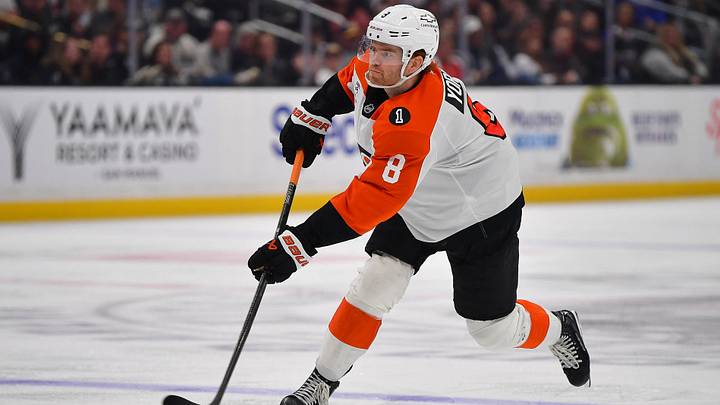
Cam York scored one of the biggest goals of his career last season when he sent the Flyers to the second round of the playoffs. It was his first career playoff goal in just his fourth career playoff game.
"Got the pass from (Michkov) there at the blue line. Saw one guy net front and just tried to put it there. We knew that it was going to be a greasy one, and it felt really good seeing that one go in," York said after the game.
York posted five shots on goal in that game, only the second time he had done so in last year's regular season and playoffs combined. It's an area of his game that the Flyers want him to tap into more. York has been viewed as an offensive-minded defenseman. He's an effective puck mover and has the power to get his shot through traffic, with his shot being clocked between 80 and 93 miles per hour.
It's not that York can't provide more offense. He needs to use that part of his game more consistently, though. In the final 10 games of the regular season, York was credited with just five shots on net. The Flyers don't need him to become a 20-goal scorer, but rather they need him to create more offensively from the back end than he has.
York finished the season with 89 shots on goal, which was fourth among Flyers' defenders and 12 behind the leader, Jamie Drysdale. During his career-high year, his 134 shots were also 12 behind the defensive leader, Travis Sanheim. So York has shown he can be one of the Flyers' most active shooters from the blue line. That part of his game wasn't as prominent last year, though.
That doesn't mean he needs to start chasing offense whenever he can. It's about recognizing moments where he can activate, whether that's joining the rush or keeping the play alive at the blue line. York should continue to play big minutes for the Flyers, and with that responsibility comes the expectation of making a greater offensive impact.
That's what Rick Tocchet wants to see more of from York. The Flyers know what he can do defensively. Now they want him to trust his offensive instincts and be more willing to make a play when he sees the opportunity.
"I think there's things he worked on this summer. And we got to continue as a staff to keep on him. Work on your shot, don't defer as much, attack," Tocchet said about his hopes for York. "He'll attack the defender at the blue line. It's okay sometimes. It's a little bit risky, but the way he moves and his lateral movement is pretty damn good. We encourage that."
Tocchet's emphasis on York not deferring as much suggests he believes there have been opportunities for him to be more aggressive with the puck. The same skill set that makes him an effective blueliner is something he can tap into in the offensive zone. He can use that lateral skating to escape defenders and create shooting opportunities for himself rather than deferring, as Tocchet noted.
York has already shown what his aggressiveness can look like on the biggest stage. The Flyers need him to do that more consistently throughout the regular season. If York can tap into his offensive side more, he can add another dimension to his game and become an even more impactful player for the Flyers.
 Add us as a preferred source on Google