

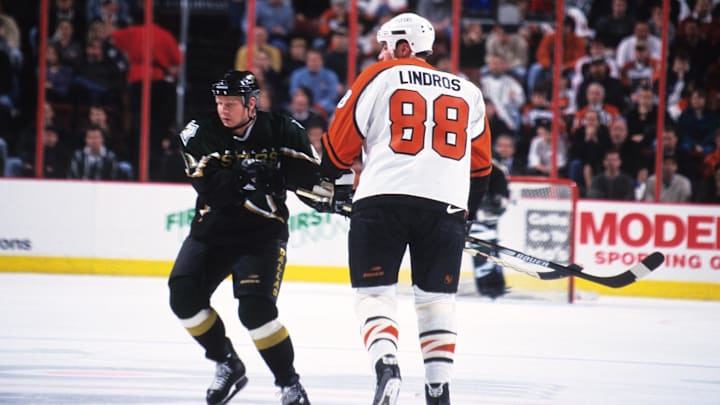
During last year's NHL draft, it was hard not to notice a trend. The Flyers were drafting big guys pretty much all across the board. Granted, as it stood at last summer, Philadelphia was still one of the shorter teams in the NHL. The idea that seemed to be generated within the Flyers organization was that they had to get bigger. This is not the first time that this was the team's mantra.
Thirty years ago, when I was in high school (dang... that long ago!), this was the dream. The GM had pretty much assembled a team that for years had averaged at least 6'0" and 200 lbs. This new incarnation of the Broad Street Bullies, led by Eric Lindros, would bash and smash its way to hockey glory.
With Lindros was a cast of guys we all remember. There was Rod Brind'Amour, Joel Otto, John LeClair, Chris Therien, Luke Richardson, Dan McGillis, and Trent Klatt. Later on, Keith Primeau and Rick Tocchet joined the team. But that's not all. Who could forget big guys like: Dan Kordic, Kjell Samuelsson, Danius Zubrus, Dan Lacroix, Chris Gratton, Kevin Haller, Karl Dykuis, etc.
And you know what these teams from 1995 to 2005 won? Nothing. They did not win a single Stanley Cup. True enough, they made it to the playoffs every year; something we would kill for just about now. Most of the time, they made it to the second round. However, this team, with its size advantage, never won the ultimate prize. Why? Because size isn't the only thing that matters. You need talent.
Yes, it is nice to be able to hit and bear your opponents into submission. But what if you can't? You need to have some savvy playmakers and skaters. In the '95, '96, and '00 playoff runs, they were stymied by the suffocating neutral zone trap employed by New Jersey (twice) and Florida. In '98, '99, and '01, they were beaten up by Buffalo (twice) and Toronto in the first round; two teams that were built to go toe-to-toe with the Flyers' physical nature.
While being physical is nice, you can't physically impose your will on a team you can't catch. The '02 and '03 Senators proved that, topping the Flyers in consecutive seasons. The following year, a younger and faster Tampa Bay team ended the Flyers in a seven-game Eastern Conference Finals.
The most glaring example is the 1997 Stanley Cup Finals. The Flyers physically demolished the Penguins, Sabres, and Rangers, losing only one game in each series. Then came the Detroit Red Wings. The Flyers were bigger physically. However, the Red Wings were faster and were much better at the passing game. They flat-out humiliated Philly in a four-game sweep, topping the Flyers by an overall score of 16-6. Ouch. I still see Detroit on a 2-1, 3-1 breakaway streaking towards Ron Hextall.
My point is this: having a large sized team is good and all. It has its advantages. However, you need talent. Being big isn't enough. Denver Barkey is smaller, but the kid can play. So could players like Theo Fleury, Alex DeBrincat, Brad Marchand, Jonathan Marchessault, and Cam Atkinson (ignoring his Flyers career). I'd rather have a fast guy speeding down the boards setting up the play who doesn't turn the puck over than a tall, lumbering giant who moves like molasses in January in Alaska.
Size is nice, but speed and hockey vision/IQ are just as important. Being big isn't going to help if they keep turning the puck over or are constantly putting the team on the penalty kill.
 Add us as a preferred source on Google