

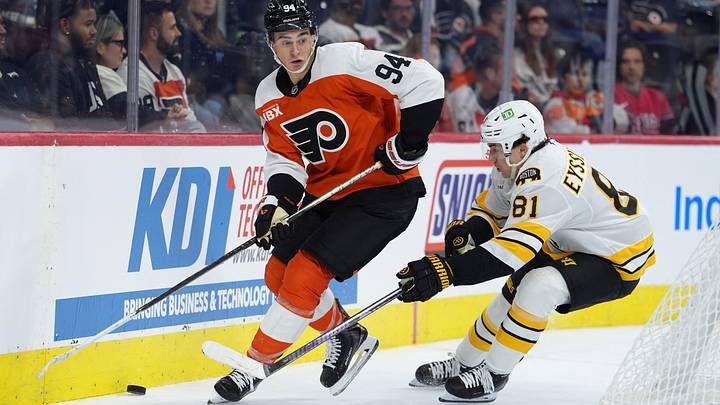
Rick Tocchet knows the power play hasn't been good enough. The Flyers have finished 30th or lower on the power play in five straight seasons. The unit had become too predictable and often spent its time on the perimeter of the zone instead of attacking.
That's no doubt part of why Tocchet challenged the coaching staff this offseason to start thinking outside the box in different areas. Coming up with different looks so they have something fresh they can bring to the players when they return to the area.
One of those things has been a new setup on the power play. Tocchet's plan was to bring in fresh players to the unit who have a strong history of being offensive players. Each of them brings something special to the group that can help them connect.
The unit itself features Trevor Zegras, Tyson Foerster, Matvei Michkov, Porter Martone, and Jamie Drysdale. It's clear right away that the unit features an abundance of young and talented players. That doesn't mean things are going to work, but it's an example of the coaching staff trying different things than in the past.
One of the wrinkles with the unit is the potential connection between Michkov and Martone. And according to Tocchet, the Flyers already have some ideas in mind for what the two of them can do together.
"We have a couple of plays where the play goes to Michkov down low; him and Porter are gonna have a two-on-one at the net. If a team gives us that all night, I want that all day. We want that play the whole time."
With Michkov operating down low, he can view how the penalty kill is structured and determine what options are available. That forces the defender to make a quick decision. He has to either cut off Michkov behind the net or cut off a possible passing lane to Martone.
That's the two-on-one situation Tocchet is referring to. And it's not a guarantee that it will always be there. But what stands out most is Tocchet's willingness to continue using that play even if it doesn't work. He wants the players on the ice to recognize the situation and use it to their advantage rather than trying to get everyone involved.
"If the team's giving us a low play, give it to (Michkov). (Michkov), do your thing with Porter. If it doesn't go in, it doesn't go in. I'll take that. I'll take the odds instead of screwing around with the puck."
And that goes back to the problems with the unit in the past. Oftentimes, it felt like the unit spent too much time searching for the perfect play rather than taking advantage of what was in front of them. Tocchet's approach is essentially the opposite. He wants the Flyers to use that play between Michkov and Martone any time it's available to them, regardless of the outcome.
The unit is fluid, and not everyone will always be set up that way to exploit that play. This makes it an even more dangerous one to use. Using it too frequently allows teams a chance to plan for it. Keeping it in their back pocket and taking what the defense gives them helps the Flyers avoid searching for those perfect plays.
For a power play that has spent too much time looking for answers, Tocchet's philosophy here is simple: Don't overthink things. Use what the defense gives you and take advantage of it.
 Add us as a preferred source on Google