

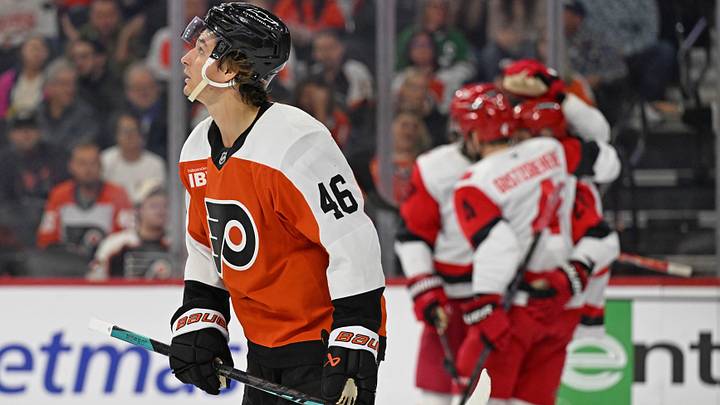
The Flyers continue to search for answers amid their 0-5-2 start. Their problems extend to both sides of the ice, but for now, let's focus on the offense. Rick Tocchet cannot keep reaching for the line blender every time this team struggles to score. There are circumstances where changes are necessary, like with the injuries to Travis Konecny and Cam York. There's a difference between changing out of necessity and constantly looking for a spark.
How can this team develop legitimate chemistry if they aren't being given time to adjust to each other? The immediate counterargument to that is clear: The Flyers can't score as is, so why does it matter who they are paired with? That's a fair question. However, there is a case to be made that constantly moving players around prevents them from getting comfortable and gaining chemistry with one another.
Against the Kraken, Tocchet has once again shuffled his lineup. There are some interesting pairings that could spark something. Matvei Michkov and Porter Martone are on the same line for the first time, Trevor Zegras and Owen Tippett are being reunited, and Jack Studnicka will debut for the Flyers on the fourth line.
The problem is that the Flyers have not run the same four lines in any game this season. The closest they have come is leaving the trio of Denver Barkey, Tyson Foerster, and Christian Dvorak together for consecutive games. Again, injuries have played a role, but the constant adjustments raise questions about whether Tocchet is giving his line combinations a genuine chance to click.
Yes, these players practice together, and most have known and played together before this season. Practicing together and playing in a game are two different things, though. Players need to anticipate where their linemates will be, understand decisions they might make, and develop in-game chemistry. That is going to take time, and it is difficult to establish when the lines are constantly changing.
Back to the counterargument for a moment. Some of the Flyers' biggest issues come from puck possession, passing execution, and getting shots on net. No amount of line combination changes will fix the lack of basic fundamentals. Consistency does give players a better chance to work through struggles because they know their linemates and can usually trust one another to make the right play.
Using Tippett and Zegras as an example, the two played over 530 minutes together last season and posted an expected-goals share of nearly 60 percent. That suggests that the Flyers controlled the quality of scoring chances when the two were together. It gives Tocchet a legitimate reason to not only revisit the combinations, but keep them together longer. Tippett's speed and willingness to attack the net mesh well with Zegras' creativity and playmaking.
We don't have the same data to back up the Martone and Michkov duo, but we can use their individual skills to infer what they could do together. The two skated together last season, but only for two minutes, so it was likely during line changes or late-game situations. However, they did outchance the opposition 3-0 and had 100 percent of the expected goals. Okay, fine, that sample size doesn't mean much. But it's fine to think about what two faces of the Flyers' future can create together.
Tocchet doesn't need to refuse adjustments and keep his lines the same no matter what. But he does need to distinguish whether a combination isn't working because the players don't fit together or because they haven't been given enough time to gel. The Flyers won't fix their offensive problems by shuffling the lines every game.
The line-blender might produce a short-term spark, but the Flyers need more than that right now. They need an offense that can sustain success, and that starts with the players being given time to prove that their trios can work.
 Add us as a preferred source on Google