

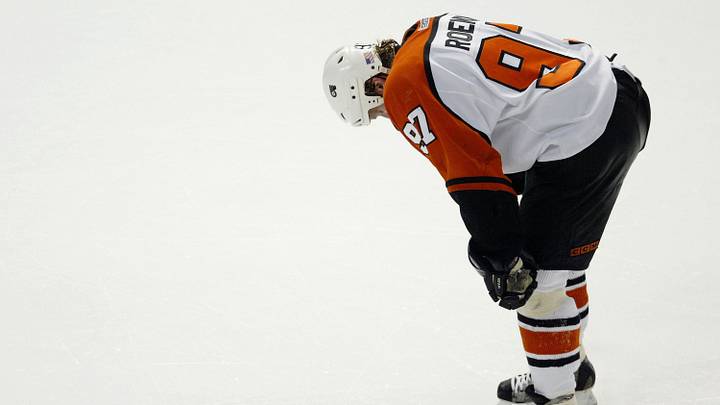
By the time the 2003-04 NHL season rolled around, the Philadelphia Flyers were well out of the Eric Lindros era and managed to remain a consistently solid team for several years. They were old in the tooth for sure, but they were a very balanced club who rode a top-10 offense and top-10 defense to 101 points and an Atlantic Division title. Then, in the playoffs, the real fun began.
The Orange and Black opened the postseason against the defending champion New Jersey Devils, facing them in the playoffs for the first time since the 2000 Eastern Conference Finals that resulted in a Flyers collapse and the end of said Lindros era. But the Flyers weren’t to be denied this time, allowing the Devils to score just nine goals in five games en route to a 4-1 series win. The Flyers were led on offense by the likes of Alexei Zhamnov (8 points) and Jeremy Roenick (7 points) in the series.
The Toronto Maple Leafs were up next, and the series was a memorable one. The Flyers opened with a pair of wins at home, Toronto held serve for the next two, then the Flyers blew them out in Game 5. That set the stage for Game 6 in Toronto, and one of the greatest finishes to any game, overtime, or series in Flyers history.
With the teams trading chances in the extra session, Toronto power forward and cheap-shot artist Darcy Tucker leveled Sami Kapanen, leaving his skates to deliver a blow to the head that would get him at least a 10-game suspension in today’s NHL. Knocked silly, Kapanen somehow scrambled to the nearby Flyers bench on his hands and knees. Less than a minute of game action later, Roenick flew down the right wing and fired the game-winner past goalkeeper Ed Belfour to silence the Toronto crowd and send the Flyers to the next round. Absolute cinema.
The 2004 Stanley Cup Playoffs featured some great moments in Flyers history — but an unfortunate ending
It all set up the main event — an Eastern Conference Finals clash with the top-seeded Tampa Bay Lightning. It was a great matchup on paper, but there was an issue for the Flyers going in. Whereas the Flyers had been through an absolute meat grinder as they defeated New Jersey and Toronto, Tampa had a two-round frolic to get to this point. The Lightning had defeated a subpar Islanders squad in five games, then cakewalked to a four-game sweep over Montreal.
Amazingly, these were also the first-ever playoff series victories for Tampa in the 12-year history of their franchise, most of which they had spent stinking out loud to that point. Neither of those teams was anywhere near as good as the two 100-point clubs the Flyers had to dispatch, and Tampa barely broke a sweat. As a result, they were at complete health entering their matchup versus the Flyers, whereas the Orange and Black looked like a MASH unit.
Whereas Tampa had lost a ludicrously low 20 total man-games to injury all season and had a completely healthy roster by the third round of the playoffs, the Flyers were hurting big-time. The greatest loss was No. 1 defenseman Eric Desjardins, who re-injured his broken arm just before the playoffs started when he was playing catch with his son, of all things. The Flyers had gotten this far without him, but the defense was paper-thin.
Kim Johnsson, Joni Pitkanen, and Marcus Ragnarsson were all dealing with injuries either before the series or sustained one during it. This forced Kapanen to shift back to defense to take regular shifts just so the team had a body back there. Never mind the fact that Kapanen was most definitely concussed by the Tucker hit and probably shouldn’t even have been playing at all. The group up front wasn’t much better, as Roenick, Zhamnov, Tony Amonte, and most of the team’s forwards were limping along, as well. Still, they fought.
The series with Tampa didn’t start great, with the rested and healthy Lightning taking a 3-1 win in Game 1. Tampa had been sitting for over a week waiting for their next opponent, and this result was eerily similar to how the Flyers got manhandled by Carolina in Game 1 of their series this past spring. The difference with the 2004 Flyers, however, is that they rebounded to emphatically take Game 2 by a 6-2 score.
A raucous Philadelphia crowd awaited the teams for Game 3 in Philadelphia, as the Flyers returned home for the first time in 11 days. It wasn’t meant to be, though, with Tampa winning 4-1. In Game 4, the Flyers again bounced back with a 3-2 win, then Tampa won Game 5 at home 4-2. Game 6 back in Philadelphia was an all-timer. With their backs against the wall, the Flyers trailed 4-3 with under two minutes left. That’s when Keith Primeau scored one of the most iconic goals in franchise history, right up there with his five-OT winner, to tie the score and send the game to overtime. Then, late in the first OT session, Simon Gagne buried one to set off a wild celebration and send things back to Game 7 in Tampa.
I remember thinking at the time that if, somehow, the Flyers could win this series and go on to the Stanley Cup that year, the pose that Primeau struck after his goal should have been immortalized in statue form outside of the arena, a fitting tribute to the guts and resiliency that the entire team had shown for that season and playoff run. But there was still Game 7 left to play.
Sadly, the Flyers had nothing left. Former Flyer Ruslan Fedotenko opened the scoring in that game, his sixth goal of the series in which the Flyers had been powerless to stop him and some of the other big guns for Tampa. Fredrik Modin added another goal to make it 2-0 before Johnsson cut the lead in half midway through regulation. But the Flyers were on absolute fumes, and there would be no comeback this time.
The seconds ticked away, and they were powerless to do anything about it. Tampa took the game 2-1, the series 4-3, and moved on to the Stanley Cup Final, where they would eventually beat the Calgary Flames in seven games for their franchise’s first title. To this day, I am convinced that the Flyers would have won that series had they gotten there, but they fell one goal short of reaching it.
Being a Flyers fan runs the full spectrum of emotions, but the predominant ones are usually anger, disgust, and disappointment when the team ultimately fails in a season or playoff series. But this time it was different. Just a total emptiness, and really a sadness for the players themselves, who had put forth maximum effort and did everything they could against an opponent who wasn’t better than them but was simply healthier and luckier. It was truly an unjust result, and the resentment was even deeper because of what was happening with the NHL.
With the collective bargaining agreement between players and owners set to expire, there was growing concern that the league would have to shut down for part or even all of the next year. This undercurrent flowed through the entire season and playoffs, bringing a real sense of urgency for teams like the Flyers. A few months after the 2004 playoffs, a lockout ensued, resulting in the cancellation of the entire 2004-05 season, and the Flyers looked very different after that.
By the time the Orange and Black next took the ice in the fall of 2005, Roenick, Recchi, Amonte, and Ragnarsson were gone. Even John LeClair moved on, signing with the hated Penguins along with Recchi. And other returning players like Primeau and Desjardins were on their last legs, with neither making it through the following season healthy before ultimately hanging up the skates.
Yes, the conclusion of the 2003-04 Flyers campaign was a painful one on many levels. They were a good club with a legitimate chance at the title, and everyone knew it was their last chance before things looked radically different. Even more so than Cup Final losses in 1997 and 2010, the 2004 team was probably the franchise’s best shot at a championship in a decades-long window. They were unable to seal the deal mostly because of a collision of circumstances rather than any actual failings by the players on the ice.
Usually, when you go deep in the playoffs and lose such an even series, it makes you hungry for more hockey immediately and for taking the final step the next season. But in this case for the Flyers and their fans, it was the end of the road for this group. And that’s why it still hurts two decades later.
 Add us as a preferred source on Google