

There are many players we watch play that we can tell will be enshrined in the Hockey Hall of Fame. There is no way Alex Ovechkin, Sidney Crosby, Patrick Kane, David Pastrnak, Claude Giroux, and Connor McDavid won't make it. They are some of the best players of this era. Some of them have spent their entire career with one team, while others joined teams looking for one last chance to have their name etched into Lord Stanley's Cup.
The Flyers have had several players who were past their prime arrive in Philly for one last chance at winning a championship. In the late 1990s, when Bobby Clarke was the general manager, he would often try to get a veteran player to add a little extra umph to the team. Players like Dale Hawerchuk and Paul Coffey were brought to Philly to help put the team over the hump.
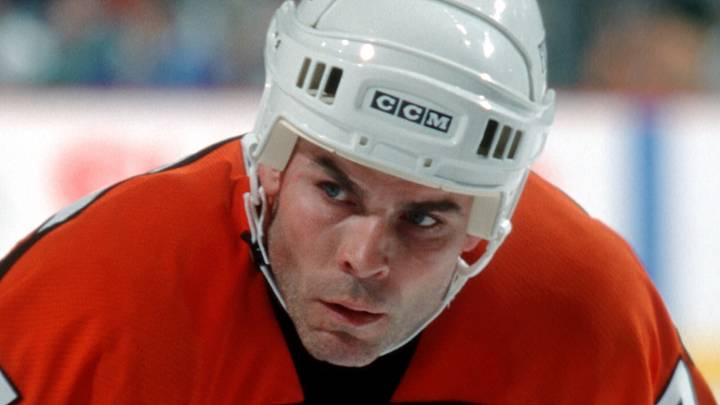
After numerous trips to the playoffs that kept falling short, Clarke made a move that ended up on my "Top Ten Worst Flyers Trades Ever" list at #4. It was a move to acquire Adam Oates. Clarke was hoping that this would be the prelude to a long-term relationship with Oates. It ended up lasting six weeks.
Oates was one of the premier centers of the 1990s. He still ranks 20th all-time in points (1,420) and is third all-time, behind Marcel Dionne and Joe Thornton, in most points without ever winning a Stanley Cup. Despite being 39 years old, he was still having a monster season with the Capitals in 2001-02. In 66 games, he scored 11 goals with 57 points. In fact, he would finish that season with the most assists in the NHL at 64. His 1,079 assists today still rank as the ninth most overall.
It was those assists that Clarke was dreaming of. Oates was an assist machine. With him at center, he could be a strong addition in the recent post-Lindros era of Flyers history. He would be the team's third-line center behind Keith Primeau and Jeremy Roenick. He could also be someone who helped elevate the games of young players like Simon Gagne, Ruslan Fedotenko, or Pavel Brendl, the top acquisition in the Lindros trade.
Trading for Oates ended up backfiring on Bobby Clarke
In his fourteen games in Philadelphia, he scored three goals with seven assists. That's not bad, but that's not much to push the needle either. However, he, like most of the team, disappeared in the playoffs. He registered just two assists as the Flyers were quickly bounced out of the postseason in five games by the Ottawa Senators, with Philly getting shut out in the final three games. Oates assisted on both of Philadelphia's goals in the entire series.
Despite winning the Atlantic Division and having the second spot in the Eastern Conference, they were upset by Ottawa. But the problems started before the postseason. In the fourteen games Oates suited up for, the Flyers won four games and tied another. They limped into the playoffs. Part of that was due to injuries to Roenick and Primeau before the playoffs.
Bill Barber, the team's coach, was also fired after the season. He had clashed with his players and, to a lesser degree, with Clarke. Despite winning a Calder Cup before with the Phantoms, he didn't jive with the vets. That instability also made Oates uneasy.
Oates himself also caused a problem. He demanded a $5 million contract. Today, that would be a cheap contract for a savvy vet. Instead, if we use inflation, that would be $9.28 million today. That would make him the highest-paid Flyer. His demands were too much for Clarke to stomach, and he was allowed to walk away in free agency. Instead, he would sign with the Ducks.
However, while contract negotiations were still on, the Flyers hammered the final nail in the coffin with a trade for Michal Handzus. Handzus came over to Philly with Robert Esche for Brian Boucher. Handzus played a few years in Philly before being traded after the lockout.
To get Oates in the first place, the Flyers had to pay a price. As you can imagine, a lot of playoff-bound teams would've loved to have his services. Clarke gave Washington a first, second, and third-round pick in the upcoming 2002 Draft. They also traded away top goalie prospect Maxime Ouellet. Ouellet turned out to be a bust, but at the time, you didn't know.
The Flyers would recover a first-round pick by trading Fedotenko, as well as a pair of second- rounders, to Tampa Bay for the fourth overall pick. With that selection, they chose Joni Pitkanen. Fedotenko became a pretty reliable second-third line scorer for Tampa. Had they kept their first- round pick, they would've had to move him to recover some draft capital. Likewise, had they kept their initial #26 pick, they could've drafted defender Duncan Keith instead.
All in all, it was a hefty price to pay for what was, in essence, just a fling. Maybe had everyone been healthy and the team not fallen apart behind closed doors, it could've been different. After all, the team was still trying to find itself after the post-Lindros-Clarke fallout. Oates as a Flyer was hardly a blip in his career and on our all-time roster. It's something that most Flyers fans have probably forgotten, and Oates probably has too.
 Add us as a preferred source on Google