

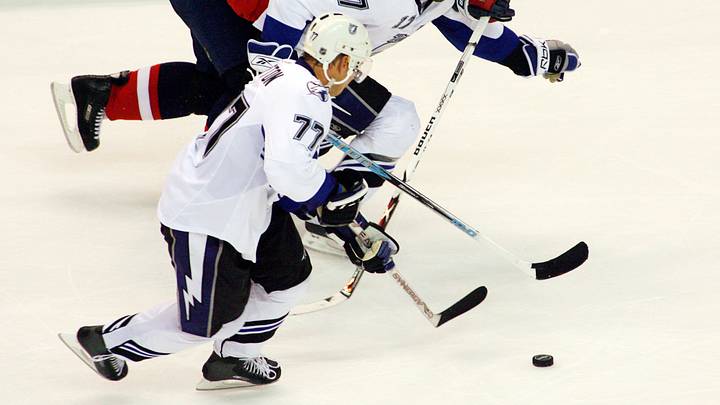
This is going to be a tense week for the Philadelphia Flyers and their fans. Will they be able to get Leo Carlsson? Will the Anaheim Ducks match the Flyers' offer sheet? If he arrives, this could drastically alter the makeup of this team. If not, the Flyers are pretty much stuck with almost the same key players they relied on this past season.
It's been a while since the Flyers dipped their toes in the RFA market. The last time was in 2012 when they attempted to snatch Shea Weber from the Nashville Predators. Paul Holmgren submitted a huge deal that the Preds surprisingly matched.
However, the Flyers tried once before. It was a disaster for the Flyers and the player involved. Now that we are in the salary cap era, this sordid tale serves as a cautionary tale.
Enter Chris Gratton
In 1996-97, Chris Gratton was a 21-year-old center for the Tampa Bay Lightning. He had a career year with 30 goals and 32 assists. The former third overall pick in the 1993 draft had finally shown what he could become. At the end of that season, he became an RFA
It was here that Bobby Clarke, the then-Flyers' GM, made his move. One year after being humiliated by the Red Wings in the Stanley Cup Finals, Clarke felt he had to make a big splash to improve his Flyers. He offered Gratton a $16.5 million contract for five years with a $9 million signing bonus, knowing that the cash-strapped Bolts couldn't match it. And so, Gratton accepted the hefty price, and the Flyers had to surrender four first-round picks to Tampa.
However, that's a high price to pay for one player. So, Clarke worked out a deal with the Lightning. Philadelphia got all of the draft picks back, but sent Mikael Renberg and Karl Dykhuis to Tampa. Renberg, of course, was the third piece of the vaunted Legion of Doom. He had had an injury-prone season prior, but was still viewed as a top-line winger. Dykhuis was a hard-hitting defender who had some scoring abilities.
It was hoped that Gratton would be the team's third center behind Eric Lindros and Rod Brind'Amour, with Joel Otto securing the fourth line. However, there was another reason for the deal. This was a time when the relationship between Clarke and Lindros showed signs of strain. If Gratton could become a megastar, perhaps it could make Lindros shape up or be shipped out.
Clarke basically declared that since Gratton had scored 30 goals for Tampa, he could easily score 40 or more for the Flyers. The pressure he put on Gratton pretty much crushed him. He had tied his career high of 62 points, set the year before, but had only 22 goals. Clarke was upset; however, he did blame himself for the unreal expectations.
Just six weeks into the next season, Gratton was traded back to Tampa with center Mike Sillinger. In return, the Flyers received Daymond Langkow and Renberg. In total, Gratton played 108 games as a Flyer, scoring 23 goals with 47 assists. The ironic thing is Gratton did enjoy a 15-year NHL career, but never put up the numbers he did in the 96-97 season. Maybe some of that is the trauma he had from dealing with Clarke. After all, he isn't the only one who suffered under Clarke's reign as GM under the weight of uber-high expectations.
Carlsson's case is probably different. He has been steadily improving and is showing he can become one of the truly elite centers in the game. Overall, the stats and age are the same as Gratton's. However, the Flyers are different now, with a different sort of roster and a different crew running the show, although Clarke remains an advisor for the team. Carlsson can be a great addition.
Even then, we need to temper our expectations. We can't assume he'll bring a Stanley Cup by himself. We can't expect him to score 40 goals and win 80% of his faceoffs. Having realistic expectations will help both him and the team if he does become a Flyer.
Gratton might have become a good player here had he been given room to breathe and grow. Let's not make the same mistake with Carlsson.
 Add us as a preferred source on Google